
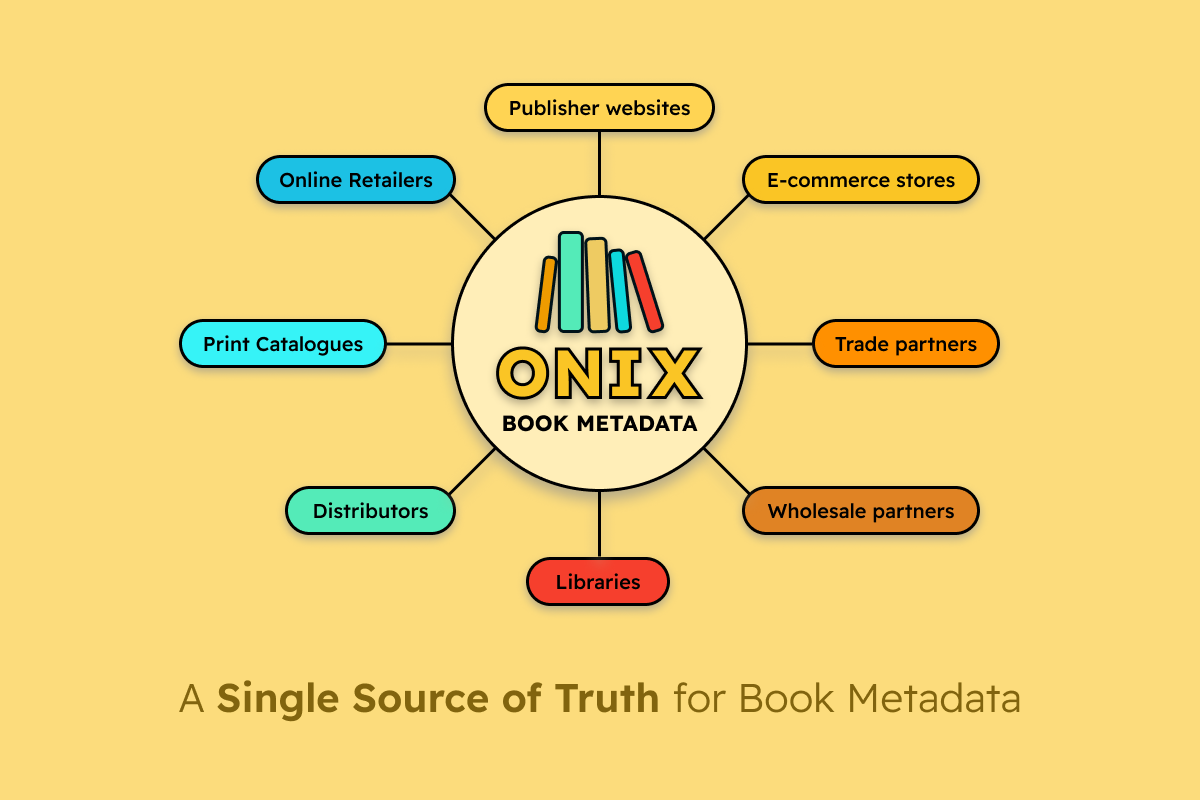
Here's a scenario that will be familiar to most publishers: you update the price on a title. You fix it in your own system, send an email to your distributor, update the spreadsheet you send to retailers, and make a note to check whether the online stores have reflected the change. Three weeks later, someone finds the old price still showing on one of them. You're not sure which version is right anymore.
It's a frustrating situation, and it's not a sign of a poorly run operation - it's just what happens when the same information lives in too many places at once.
The scattered data problem
Most publishers start the same way - a spreadsheet that tracks titles, ISBNs, prices, and contributor names. It works fine at first. Then you add a second retailer, a distributor, a website, maybe a wholesale partner. Each one wants your data in a slightly different format. So you maintain multiple versions: one spreadsheet for the distributor, a different export for the online store, a PDF catalogue for the sales rep.
At some point, one of these gets out of sync. A cover image changes but only gets updated in some places. A book goes out of print but the old listing stays live on a platform you forgot to notify. A contributor's name is spelled differently in two different systems.
The more channels you're selling through, the worse this gets. And every time you add a new platform or partner, the problem compounds.
What "source of truth" actually means
A source of truth is simply one authoritative record for each piece of information. Not one system that copies data to other systems - one place where the data lives, and everything else refers to it.
The practical difference is significant. If your book's retail price lives in one place and your distributor, your online store, and your PDF catalogue all pull from that same record, then changing the price once changes it everywhere. If that record also holds the current cover image, the contributor credits, the description, the availability status - all of those stay consistent too.
Without a source of truth, you're maintaining the same information in multiple places. And the longer you do that, the harder it becomes to know which version is correct.
Where ONIX XML fits in
ONIX is the global standard format for book product data. It defines what a book record contains and how it's structured - not just the obvious things like title and ISBN, but contributor roles, subject classifications, territorial rights, pricing, availability, and more. It was designed specifically so that publishers, distributors, retailers, and libraries can all work from the same data without losing anything in translation.
That's what makes it a natural fit for a source of truth approach. When your book data is in ONIX format, it's not tied to any one platform or tool. An ONIX record carries everything a retailer needs to list a book accurately, everything a library needs to catalogue it, everything a distributor needs to handle it. The same structured record can feed a WooCommerce store, a Shopify site, an Amazon listing, a library supplier, and a print catalogue - without being re-formatted or re-entered for each one.
The key word there is structured. A spreadsheet can hold the same information, but it doesn't have a shared definition of what each field means or how it should be interpreted. ONIX does. That shared definition is what makes the data portable and reliable across different systems and partners.
What changes when you have one
The immediate practical benefit is consistency. When your book data comes from a single ONIX-formatted source, your retailer listings, your distributor feeds, and your own store all show the same information. Updates flow through. Corrections don't get missed.
The less obvious benefit is trust. Retailers and distributors that receive clean, consistent ONIX data treat it differently to data that arrives in various formats and needs manual checking. It reduces friction at every point in the supply chain.
And the long-term benefit is scale. Adding a new retail partner or distribution channel is straightforward when your data is already structured correctly — your data is already in the right shape to share with them.