
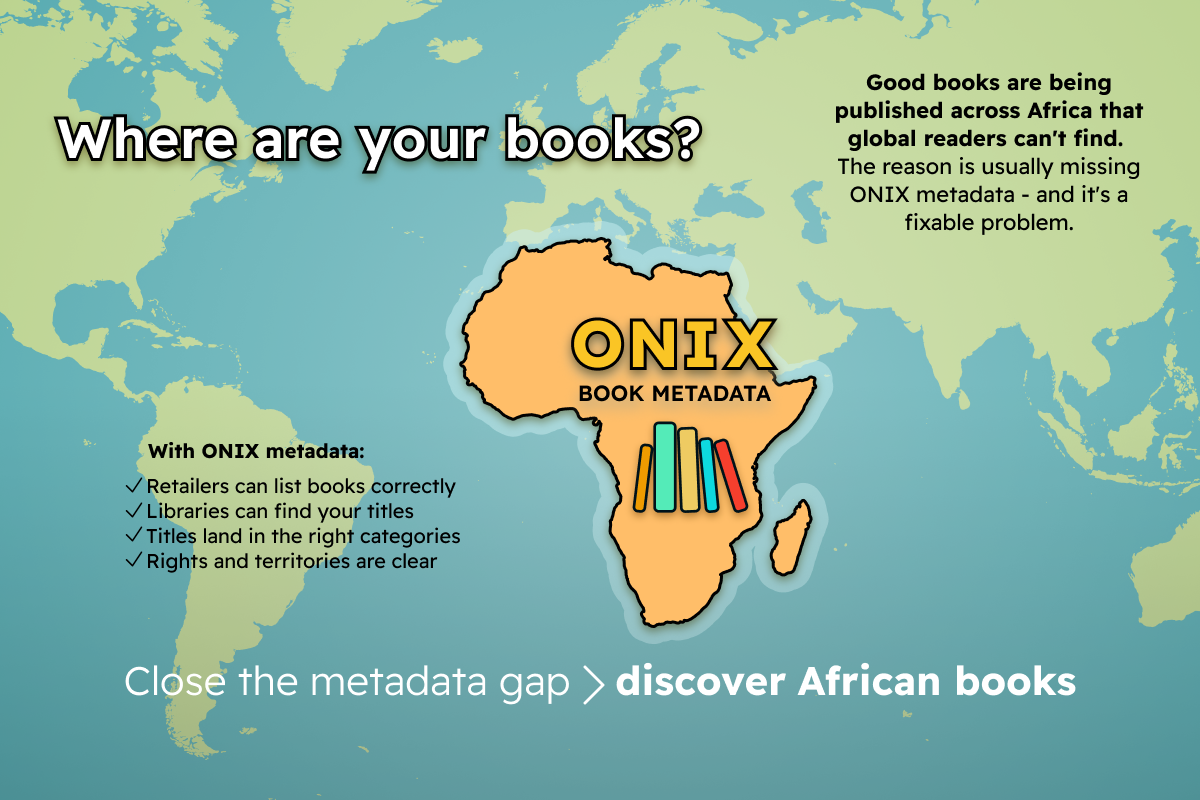
There are good books being published across Africa right now - in English, Afrikaans, isiZulu, isiXhosa, Setswana, French, Swahili - that almost nobody outside the publisher's home market can find. Not because they're hard to get hold of. Because they're invisible.
When a bookseller, library, or online retailer goes looking for a title, they're not browsing a shelf. They're querying a database. And that database runs on metadata - specifically, structured product data in a format called ONIX. If your book isn't in that format, it doesn't exist in the places that matter.
This isn't a niche technical problem. It's the reason a children's book published in Cape Town doesn't show up when a librarian in Nairobi - or London, or Toronto - searches for picture books in isiZulu. The book exists. The metadata doesn't.
What ONIX actually is
ONIX is the global standard for sharing book information across the publishing supply chain. It's an XML format that carries everything about a title: the ISBN, price, availability, contributor details, subject classifications, rights territories, and more. When you send an ONIX file to a retailer or distributor, they can list your books accurately without anyone re-typing anything.
Most large publishers in the UK, US, and Europe have been using ONIX for years. For many African publishers - particularly smaller independents - it's either an unfamiliar standard or something they know they should be doing but haven't had the tools or support to tackle.
The result is a gap. Not a gap in quality or output, but a gap in discoverability.
The scale of the problem
In May 2025, a panel hosted by the Stanford Humanities Center brought together some of the key people working on this issue in South Africa. The conversation was direct: improving ONIX metadata adoption is one of the most important things African publishers can do to make local titles visible in digital catalogues, libraries, and bookstores worldwide. The problem is especially acute for books in indigenous languages, which are exactly the titles that need the most help reaching the right readers.
PASA (the Publishers' Association of South Africa) has been taking this seriously. In early 2025 they ran a full-day metadata workshop in Cape Town bringing in specialists from EDItEUR (the organisation that maintains the ONIX standard), BISG, BookNet Canada, and the Kenyan Publishers Association. They also funded ONIX training for South African publishers across the year, targeting 70 people. That's not a small number for an industry of this size.
The broader African picture isn't much different. The 3rd African Publishers Conference, held in Casablanca in June 2025, addressed digital visibility and distribution as persistent structural problems - not technical edge cases, but fundamental barriers to the continent's publishers reaching readers beyond their immediate markets.
Why this is happening now
Part of what's driving urgency is external pressure. Amazon updated its requirements for ONIX compliance in early 2026, meaning publishers who want accurate listings on the world's largest book platform need to be sending properly structured ONIX 3.0 data. For publishers who weren't already doing this, it was a forcing function.
But the more important driver is the opportunity itself. African publishing is growing. There's genuine global interest in African voices, African stories, and books in African languages. The demand is real - but it can't be met if the supply chain doesn't know the books exist.
What changes when you get this right
When a publisher sends good ONIX data, a few things happen. Retailers can list the books correctly without chasing the publisher for information. Libraries can find and catalogue titles they'd otherwise miss. Subject classifications (using the Thema system, which plugs into ONIX) mean a book about South African history ends up in front of readers interested in that subject, not buried in a generic "Africa" category. And if you're selling internationally, rights and territory data in the ONIX record means the right retailers see the right titles for their market.
None of this is magic. It's just accurate, structured information in the right format.
The metadata gap is real, it's fixable, and the African publishing industry is starting to close it. For publishers who get ahead of this now - particularly those with multilingual catalogs or titles in indigenous languages - the upside is significant. Global readers are looking. The question is whether your books are where they'll find them.
Further reading:
- ONIX for Books - EDItEUR overview
- PASA Product Metadata Guidelines (PDF, November 2024)
- PASA Metadata resources and training
- South Africa and ONIX Metadata - Stanford Humanities Center panel (May 2025)
- Amazon ending ONIX 2.1 support (March 2026) - BookNet Canada
- UNESCO: The African Book Industry (2025 report overview)